Digital Inclinometer Explained: A UK Buyer's Guide
Digital Inclinometer Explained: A UK Buyer's Guide
Key Takeaways
- A digital inclinometer provides highly accurate angle measurements (often to ±0.1°) using internal micro-electromechanical systems (MEMS).
- UK building regulations, such as Part K for staircases and Part H for drainage falls, require a level of precision that traditional analogue spirit levels struggle to consistently deliver.
- For British job sites, an IP65 rating is essential to protect the internal sensors from brick dust, plaster, and unpredictable weather.
- Choosing a model with a magnetic V-groove base allows for hands-free operation on steelwork and pipe fabrication.
A digital inclinometer is an electronic device designed to measure angles of slope, elevation, or depression with absolute numerical certainty. In modern British construction, metal fabrication, and professional carpentry, the margin for error is virtually non-existent. Whether you are setting the pitch of a roof in November drizzle or calibrating a cast-iron table saw blade for bespoke joinery, relying on a standard bubble level often leaves too much room for human error. Based on our extensive testing at DigitalAng, a slight miscalculation at the base of a structural installation can quickly compound into a costly, visible mistake by the time you reach the apex.
Consequently, this is where the digital inclinometer becomes indispensable. Having rapidly transitioned from a specialist gadget to a mandatory staple in the modern tradesman's toolbag, this tool entirely removes guesswork. This guide explores the mechanics behind digital inclinometers, why they are critical for compliance with UK building standards, and what features separate professional-grade equipment from unreliable alternatives.
What is a digital inclinometer used for?
An inclinometer, sometimes referred to as a tilt sensor or clinometer, is fundamentally an instrument used for measuring angles of slope (or tilt) with respect to gravity. While analogue versions have existed for over a century—relying on pendulums or liquid vials—the digital inclinometer represents a massive leap forward in both accuracy and usability on site.
At the core of a modern digital inclinometer is a microscopic piece of technology known as a MEMS (Micro-Electro-Mechanical Systems) sensor. These advanced sensors contain tiny, suspended silicon structures that shift when the device is tilted. As gravity pulls on these microscopic structures, the movement alters the electrical capacitance within the sensor. Furthermore, the tool's microprocessor instantly translates this change in capacitance into a highly precise digital readout on an LCD screen.
Unlike a traditional spirit level, which requires the user to visually judge the position of a bubble between two lines, a digital inclinometer provides a definitive number. For instance, if a structural support needs to sit at precisely 87.5 degrees, the screen will tell you exactly when you have achieved it, entirely removing human interpretation.
Why are digital inclinometers important in UK construction?
The shift towards digital measurement tools in the UK is largely driven by stringent building regulations and the high cost of site rework. According to industry data regularly cited by bodies like the Federation of Master Builders (FMB), rework and defect correction can account for up to 5% of total construction costs in the UK. As a result, a significant portion of this rework stems from dimensional inaccuracies and incorrect falls established early in a project.
Consider the strict requirements of the UK Building Regulations. According to UK guidelines in Approved Document K, which covers protection from falling, collision, and impact, there are exact criteria for the pitch of stairs. Private stairs must have a maximum pitch of 42 degrees, while utility stairs are restricted to 33 degrees. Attempting to verify these exact angles with a rudimentary tool invites failure during building control inspections.
Similarly, Approved Document H dictates the strict requirements for drainage and waste disposal. Establishing the correct fall for a pipe—typically 1:40 or 1:80 depending on the application—is absolutely critical to ensure self-cleansing velocity. Ultimately, a digital inclinometer allows groundworkers and plumbers to set these shallow gradients with complete confidence, ensuring compliance and preventing costly blockages down the line.
What to look for when buying a digital inclinometer?
However, not all digital measuring tools are created equal. When selecting a digital inclinometer for rigorous site work, specific features are required to ensure the tool survives the demanding environment and delivers consistent, reliable results.
1. IP65 Rating: Dust and Water Resistance
The British climate and the reality of an active building site are inherently hostile to sensitive electronics. Brick dust, wet plaster, and sudden downpours can quickly destroy poorly sealed equipment. Therefore, an IP65 rating is a non-negotiable feature for professional use. The '6' indicates the unit is completely dust-tight, preventing fine particulate matter from interfering with the delicate MEMS sensor. The '5' signifies protection against low-pressure water jets from any direction, meaning the tool will easily survive heavy rain or being splashed during wet-cutting tasks.
2. Magnetic V-Groove Base
Hands-free operation drastically improves both safety and efficiency, particularly when working at height or operating heavy machinery. A strong magnetic base allows the inclinometer to grip firmly to RSJ beams, scaffolding, and saw blades. Moreover, a V-groove design takes this a step further by allowing the tool to sit perfectly aligned on curved surfaces, such as copper piping or steel conduit. For a deeper dive into how magnets enhance precision work, you can read our comprehensive guide to magnetic angle finders.
3. Relative Zero (Incremental Measurement)
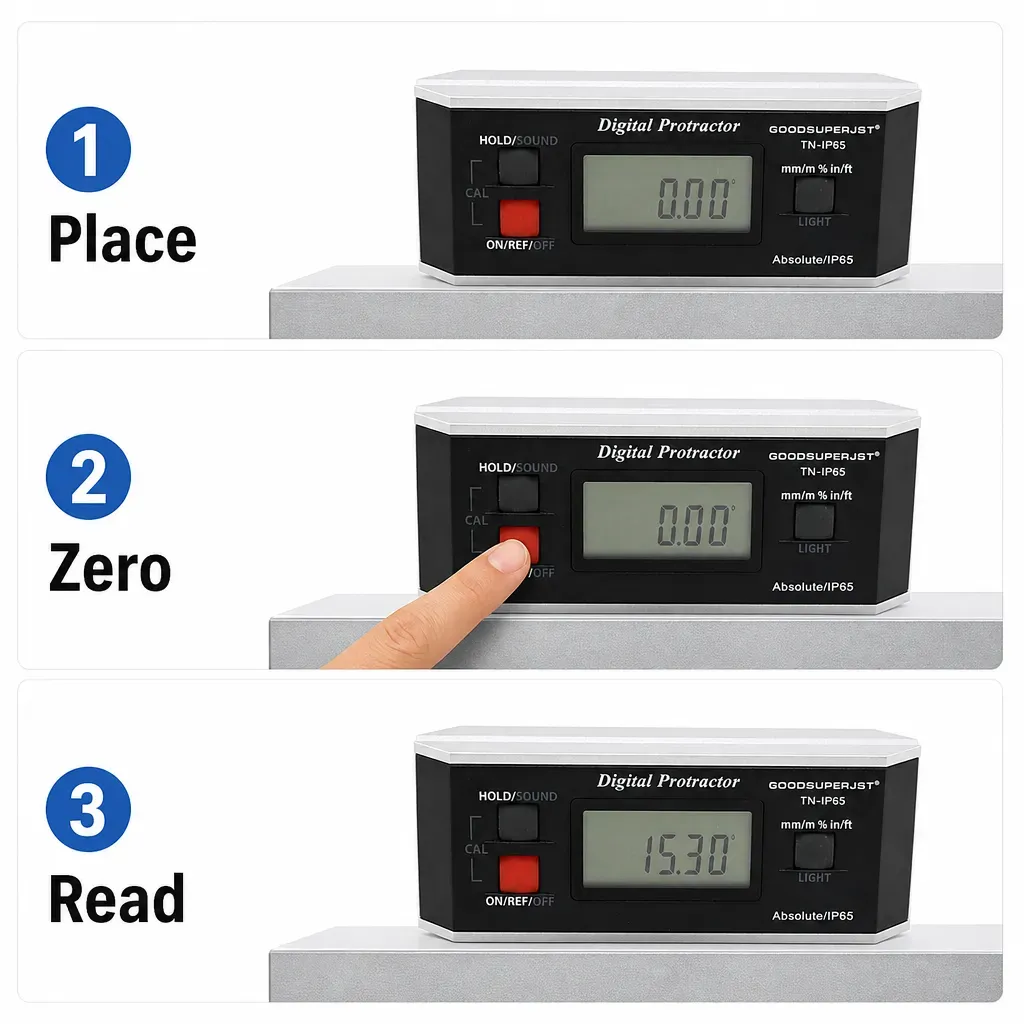
The relative zero function, often labelled as 'Zero' or 'Inc', allows you to set the current angle of the tool as 0.0 degrees, regardless of its actual relation to true earth level. This is incredibly useful for transferring angles or measuring the exact difference between two adjacent surfaces. For example, if a floor is slightly out of level, you can place the inclinometer on the floor, hit zero, and then measure the angle of a skirting board relative to that specific floor.
4. Display Readability and Backlighting
A high-contrast, backlit LCD is vital for working in poorly lit environments, such as roof voids, basements, or during the shorter winter days in the UK. In our experience, premium models also feature auto-inverting displays; when the tool is turned upside down to measure the underside of a lintel or beam, the numbers on the screen automatically flip right-side up, preventing costly misreadings.
How do you use a digital inclinometer on the job site?
The versatility of a digital inclinometer makes it a daily-use item across multiple UK trades, offering specific advantages depending on the application.
Woodworking and Joinery
In the workshop, absolute precision is paramount. Cabinet makers and joiners use digital inclinometers to meticulously calibrate their machinery. By setting the bevel angle of a table saw or a compound mitre saw to exactly 45.0 degrees, tradespeople can ensure that bespoke corner joints meet flawlessly, thereby eliminating the need for wood filler.
Ready to upgrade your kit with DigitalAng?
Get Yours Now — £74.99