Mitre Angle Finder Explained: A UK Buyer's Guide
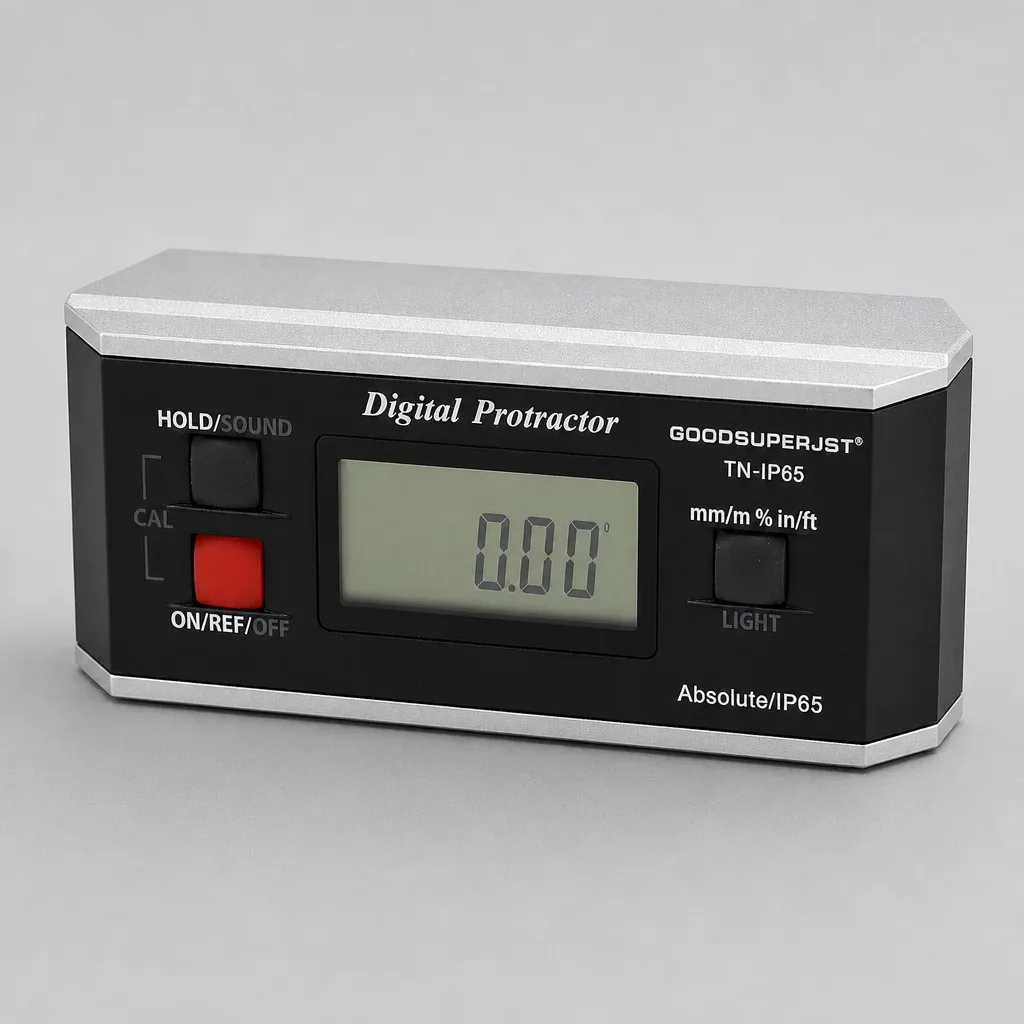
When a corner is out by even a fraction, the gap shows. That is why a mitre angle finder is one of the most useful measuring tools for UK carpenters, joiners, decorators, property renovators, and capable DIYers working on skirting, architraves, coving, trims and bespoke joinery.
DigitalAng’s approach is simple: keep the tool site-proof, keep the reading reliable, and keep the workflow fast enough for real jobs in real British conditions — from cold garages and damp gardens to dusty loft conversions and busy refurbishment sites.
Key Takeaways
- A mitre angle finder measures and transfers internal or external corner angles so you can set saws and cuts accurately.
- It is especially useful on UK properties with non-standard corners, such as Victorian terraces, bay windows, and uneven plastered walls.
- Look for clear resolution, good repeatability, robust hinges, and practical features such as zero/reset and a readable display.
- IP65 protection is valuable on site because it helps guard against dust and water ingress in harsh working conditions.
- If you want one tool that can handle tougher environments, the Site-Proof IP65 Digital Protractor & Angle Finder is built for that job.
Stat to know: the Health and Safety Executive (HSE) estimated that 604,000 workers in Great Britain suffered a non-fatal work-related injury in 2023/24. Accurate measuring tools will not solve every site problem, but they do reduce rework, wasted cuts, and the needless handling that slows a job down.
Source: HSE, Work-related fatal and non-fatal injuries in Great Britain 2023/24.
What a mitre angle finder does on a UK job
A mitre angle finder tells you the angle of a corner so you can divide it correctly and cut two pieces that meet neatly. In practice, that means less trial-and-error when you are fitting skirting boards, picture rails, architraves, coving, dado rails, trim or light carpentry details.
Most corners are not perfect 90-degree squares. That is especially true in older UK housing stock, where settlement, mixed materials and years of alterations can leave walls slightly out. A mitre angle finder helps you measure the actual corner rather than relying on an assumption that the room is square.
The real advantage is transfer. You are not just finding a number; you are moving that number from the wall or joint straight to the saw, which keeps the workflow tight and the fit cleaner.
Why a mitre angle finder matters in British homes and trade work
Anyone who has fitted trims in a Victorian terrace or tried to dress a bay window knows that a “standard” angle is often not standard at all. Corners can open, close, or drift just enough to make a neat mitre look wrong once the pieces come together.
That is where a mitre angle finder earns its keep. It removes guesswork before the cut is made. For tradespeople, that means fewer return visits and cleaner handovers. For DIYers, it means less waste and less frustration when a length of timber has already been cut.
It also supports a more sensible workflow on site. Under the Provision and Use of Work Equipment Regulations 1998 (PUWER), equipment used at work should be suitable, maintained and used correctly. A reliable measuring tool is a small part of that wider discipline, but it has a direct impact on workmanship.
If you are comparing tools for different angle tasks, our Ultimate Guide to Magnetic Angle Finder in the UK is a useful companion read, especially if your work includes setting out on metalwork or machinery housings.
How to use a mitre angle finder for accurate cuts
Step 1: Place the arms against both faces of the corner
Open the tool and seat each arm firmly against the two surfaces that form the corner. The goal is full contact, not a rough visual estimate. If the corner is uneven, move the tool slightly until it sits naturally without rocking.
Step 2: Read the angle before you cut
Once the arms are aligned, take the reading. On a digital mitre angle finder, the display should be clear enough to read without squinting, even in poor light. In a loft conversion or a dim hallway, that matters more than people think.
Step 3: Transfer the angle to the saw or mitre box
The measured corner is not usually the same as the cut angle. For internal and external corners, you need to split the angle correctly so each piece meets cleanly. If you are unsure of the transfer method, a Angle Gauge Explained: A UK Buyer’s Guide can help with the practical side of reading and moving angles between tools.
Step 4: Check before you commit to the final cut
It is often worth making a quick dry fit with offcuts, particularly on visible work such as skirting or moulding. A mitre angle finder should save time, not create false confidence. A ten-second check can save a full strip of timber.
What to look for in a mitre angle finder before you buy
Not all angle finders are equal. The most useful one for trade and serious home use is the model that combines accuracy with durability and a display you can trust in poor conditions.
- Accuracy and resolution: Look for a tool that gives a fine enough reading for trim work. Small errors become visible on wider mouldings.
- Repeatability: A good mitre angle finder should give the same reading when you return to the same corner.
- Robust hinge action: If the pivot is sloppy, the angle is only an estimate.
- Clear zero/reset function: This helps with transfer work and comparative readings.
- Readable screen: A large, clear digital display saves time on dim sites and reduces mistakes.
- Dust and water resistance: IP65 protection is valuable on British sites where rain, damp and sawdust are part of the day.
- Build quality: Lightweight is useful, but not at the expense of rigidity or durability.
For the technical side of ingress protection, IP65 is defined under BS EN 60529. In simple terms, the “6” means dust-tight protection and the “5” means resistance to water jets. That is a practical match for many UK trade environments, where tools face far more than a clean bench.
How a mitre angle finder compares with related angle tools
A mitre angle finder is designed for corner measurement and transfer. That is its main job. A digital inclinometer, by contrast, is more suited to slopes, pitches and level checks, while an angle gauge can be useful when you need a simple mechanical reference or a transfer tool for repeated shapes.
If your work extends beyond corners into slope measurement — for example, checking a staircase pitch, roof incline or drainage fall — our Digital Inclinometer Explained: A UK Buyer’s Guide gives a more focused breakdown of that use case.
For a broader comparison between measuring styles and when to choose each one, it is also worth reading the Ultimate Guide to Magnetic Angle Finder in the UK. That article is especially helpful if you want to understand how different angle tools fit into the same workflow.
The short version is this: a mitre angle finder is the right tool when the problem is a corner, not a slope. Choose the tool that matches the job and you will work faster, with less confusion.
Why site-proof features matter in a mitre angle finder
UK jobs are not always tidy, warm or dry. A tool that works well on a kitchen bench can be frustrating on a site covered in plaster dust, damp timber and wet concrete boots. That is why DigitalAng’s Site-Proof IP65 Digital Protractor & Angle Finder is positioned for harsh environments rather than showroom conditions.
Dustproof protection matters because fine debris can affect hinges, buttons and display visibility. Water resistance matters because rain, spray and condensation are a normal part of work in the UK. Drop resistance matters because tools get knocked off benches, ladders and scaffold boards. If the measuring tool fails after one accident, it is not a reliable trade companion.
There is also a human factor. Repeatedly recutting a poor mitre is tiring and demoralising, and it adds unnecessary handling. The NHS regularly advises people not to ignore persistent wrist, elbow, shoulder or back pain from repetitive work. A good mitre angle finder cannot replace safe working habits, but it can reduce avoidable repetition.
How to avoid common mitre angle finder mistakes
Most bad results do not come from the tool itself. They come from rushed use, poor contact with the corner, or confusion when transferring the measurement to the saw.
- Do not measure on damaged surfaces without checking the true line. Loose plaster, swollen timber or bead can throw the reading off.
- Do not assume a room is square. Many UK rooms are not, particularly in older properties.
- Do not ignore the transfer step. The measured corner and the saw setting are not always the same thing.
- Do not rely on a tool with obvious hinge play. Any looseness reduces trust in the reading.
- Do not keep using a tool with a fogged or hard-to-read display. If you cannot see the reading clearly, the risk of error rises fast.
One useful habit is to check the same corner twice from slightly different positions. If the reading is stable, you can proceed with more confidence. If it changes, the issue is likely the surface, not your saw.
Who needs a mitre angle finder most
A mitre angle finder is valuable for anyone who cuts internal or external corners regularly. That includes joiners, carpenters, decorators, fitted furniture installers, handyman services, landlords doing patch repairs, and experienced DIYers who want a cleaner finish.
It is particularly useful for people working in British housing stock where corners are rarely textbook-perfect. Bay windows, stair nooks, chimney breasts and period skirting can all require more than a basic mitre box and guesswork.
If you are just starting out, a mitre angle finder can also build confidence. It gives you a number to work from, which is often easier than trying to “eyeball” a cut and hoping the fit looks right after the first pass.
Where the Site-Proof IP65 Digital Protractor & Angle Finder fits in
DigitalAng’s hero product is built around the realities of UK trade work: dust, damp, drops and inconsistent light. A mitre angle finder that is 100% dustproof and highly water-resistant is a practical upgrade when your work environment is less than ideal.
The benefit is not just toughness. A digital display can speed up reading and reduce uncertainty, while a precise, repeatable mechanism helps you trust the measurement when you are setting out expensive finish materials. That combination matters when every cut shows.
If your day includes mixed tasks, the right measuring kit can keep things moving. A mitre angle finder is the corner specialist, while the wider angle-measurement family is covered in our magnetic angle finder guide and the angle gauge buyer’s guide. Used properly, they complement one another rather than compete.
Buy a mitre angle finder that suits real UK conditions
If you need a mitre angle finder for regular use, do not buy on price alone. Look at the build quality, the display, the ingress protection, and whether the tool feels precise enough to trust on a visible finish job.
The Site-Proof IP65 Digital Protractor & Angle Finder is designed for the kind of work British trades actually do — not just the neat, dry jobs, but the awkward ones in cold porches, wet gardens, renovation sites and busy commercial spaces.
View the Site-Proof IP65 Digital Protractor & Angle Finder and choose a mitre angle finder built for site use, accurate readings and dependable performance in harsh conditions.
Frequently Asked Questions about mitre angle finder use
What is the main purpose of a mitre angle finder?
A mitre angle finder measures the angle of a corner so you can cut two pieces to meet accurately. It is most often used for skirting boards, architraves, coving, trim and other finish carpentry where a neat joint matters.
Is a mitre angle finder useful in older UK houses?
Yes. Older UK homes often have corners that are slightly out of square because of settlement, repairs or uneven plaster. A mitre angle finder helps you measure the actual corner instead of assuming a perfect 90 degrees.
What should I look for when buying a mitre angle finder?
Focus on accuracy, repeatability, a firm hinge, a clear display and real-world durability. If you work on site, IP65 protection is a strong advantage because it helps the tool cope with dust and water.
How does a mitre angle finder differ from a digital inclinometer?
A mitre angle finder is built for corner angles and transfer work. A digital inclinometer is better suited to slopes, pitches and level checks. If you want to compare them in more detail, see Digital Inclinometer Explained: A UK Buyer’s Guide.
Ready to upgrade your kit with DigitalAng?
Get Yours Now — £74.99